How to tell if a rock might be a meteorite
Have you found a dark, heavy rock and wondered if it fell from space? Here are three simple checks to try with a grown-up. They cannot prove that a rock is a meteorite, but they can show when it is almost certainly an Earth rock.
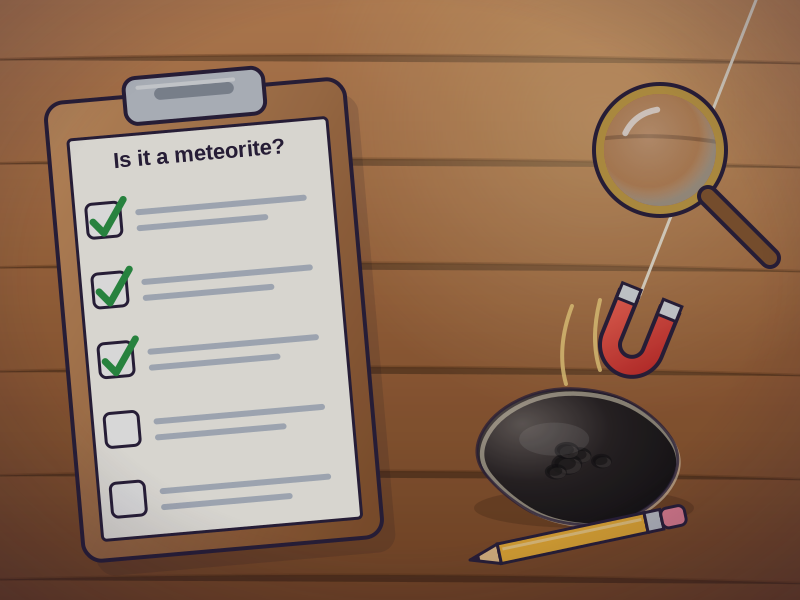
Meteorites are rare. Most rocks that people think are meteorites turn out to be Earth rocks, or waste left over from making metal. Collectors call these look-alikes meteor-wrongs.
Finding out that your rock is from Earth is still good science. Real scientists check rocks in just the same way.
The magnet test
You need: a strong magnet and a piece of thread.
- Ask your grown-up to tie the magnet to the thread, so that it hangs down and can swing.
- Hold the thread still. Slowly bring the rock close to the magnet, without touching it.
- Watch carefully. Does the magnet swing towards the rock?
What it means
- It swings towards the rock. Most meteorites have iron metal inside, so they pull a magnet. But this does not prove it is a meteorite. Magnetite, an Earth rock, pulls a magnet strongly too. So do slag from old furnaces and things made of iron, like old bolts and tools.
- It does not move. The rock is probably from Earth. But a few meteorites hardly pull a magnet at all. Many of these are a rarer kind called achondrites, such as rocks from the Moon, Mars and the asteroid Vesta.
Remember: Never stick the magnet onto the rock. It can chip the outside, and it can spoil tiny clues that scientists study.
The streak test
You need: a white tile with a rough, unshiny back, like the back of a bathroom tile.
- Turn the tile over, so the rough side without the shiny glaze is on top.
- Ask your grown-up to rub one small corner of the rock firmly across the tile, in one short stroke.
- Wipe away any loose bits. Look at the colour of the line left on the tile. This line is called the streak.
What it means
- No streak, or only a faint grey one. This is what most meteorites leave. But lots of Earth rocks leave no streak either, so this does not prove it is a meteorite.
- A red-brown streak, the colour of rust. This is haematite, an Earth rock that is often mistaken for a meteorite.
- A black or dark grey streak. This is usually magnetite, another Earth rock.
Remember: A strong red-brown or black streak means the rock is almost certainly from Earth. Only rub one small corner: if the rock is a meteorite, its outside is precious to scientists.
Look for a fusion crust
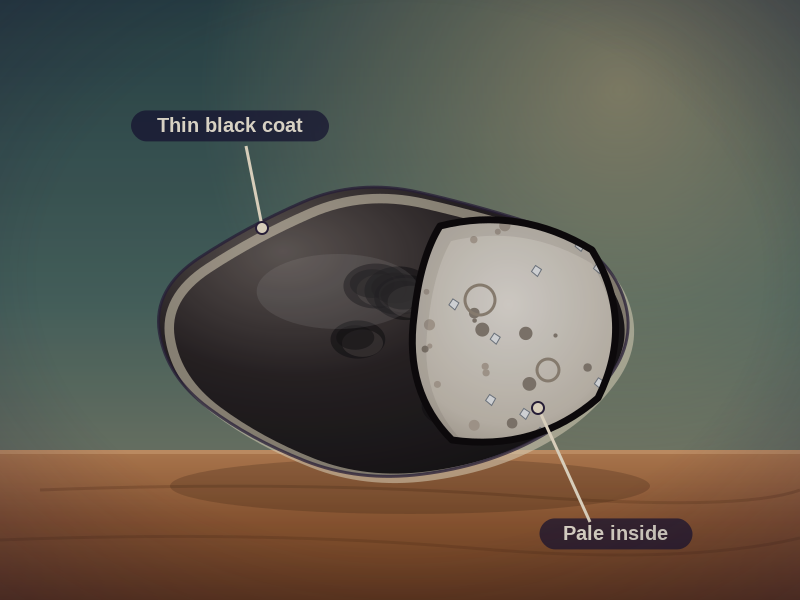
A fusion crust is a thin, dark coat on the outside of a meteorite. It forms when the outside of the rock melts as it rushes through the air.
You need: good daylight, and a magnifying glass or a phone camera zoomed in.
- Is there a thin, dark coat on the outside? It can look like an eggshell wrapped round the rock. It is usually thinner than a coin, and on a fresh meteorite it is often black.
- Is there a chipped corner? On a meteorite, the inside usually looks lighter than the dark coat.
- Can you see fine lines, like tiny frozen streams? These are flow lines, made as melted rock flowed backwards during the fall.
- Are there smooth, shallow dents, like thumbprints pressed into clay? Scientists call them regmaglypts.
What it means
- A thin, dark crust with no bubbles is one of the best clues that a rock fell from space.
- A brown, rusty crust. Meteorites that have lain on the ground for years can turn brown and rusty. So a brown crust can still be a clue.
- A thick, shiny, glassy coat with bubbles in it is more likely to be slag. A real fusion crust is not bubbly.
Remember: Never scrub, wash or file the crust off. It is one of the most important clues.
What doesn't count: clues that it is an Earth rock
Some clues show straight away that a rock is not a meteorite.
- Holes and bubbles
- Round holes and bubbles mean the rock was melted on Earth and gas bubbled out of it. It is probably slag, the waste left over from making metal, or lava rock from a volcano. Meteorites are solid inside, with no bubbles.
- Layers or stripes
- Flat layers, like the pages of a closed book, mean the rock probably formed from sand or mud. It is a sedimentary rock, such as sandstone. Meteorites do not form in layers like this.
- Glassy white crystals
- Clear, white or milky grains that look like glass are usually quartz. Quartz is very rare in meteorites, so it means the rock formed on Earth.
- Things made by people
- Bolts, old tools and lumps of rusty iron can be dark, heavy and magnetic. They were made by people, so they are not meteorites.
How to be sure
The only way to be sure is to have it checked by a museum or a university lab.
Does your rock pass all three checks? Then ask your grown-up to email clear photos of it to a natural history museum or a university. Many will give a first opinion for free.
If you think you have found one
- Tell a grown-up. Do not scratch, wash or break the rock.
- Take clear photos in daylight from different sides, with a ruler or a coin next to the rock to show its size.
- Write down where and when you found it. A phone map can show the exact spot.
- Keep it dry in a paper bag or a box.
- In the UK, a meteorite usually belongs to whoever owns the land where it was found, so always ask first.
Experts at one big museum say that about 9 out of every 10 possible meteorites that people bring them are really slag.
Print the meteorite detective checklist and tick off each clue as you check a rock with a grown-up.